
Peruvian Jungle: What to Pack and What to Expect on Your First Trip to Iquitos?
Imagine a vibrant city, full of motorbikes, exotic markets, and an enveloping heat, completely surrounded by the immense Amazon River and the densest rainforest in the world. That's Iquitos, the largest city in the world to which... It is not accessible by road..
Visiting the Peruvian Amazon is a stark contrast to the cold mountains of Cusco or Puno. It's an experience of pure connection with nature, a break from technology, and pure adventure. If you're venturing into the jungle for the first time, here's exactly what to expect and how to pack your backpack.
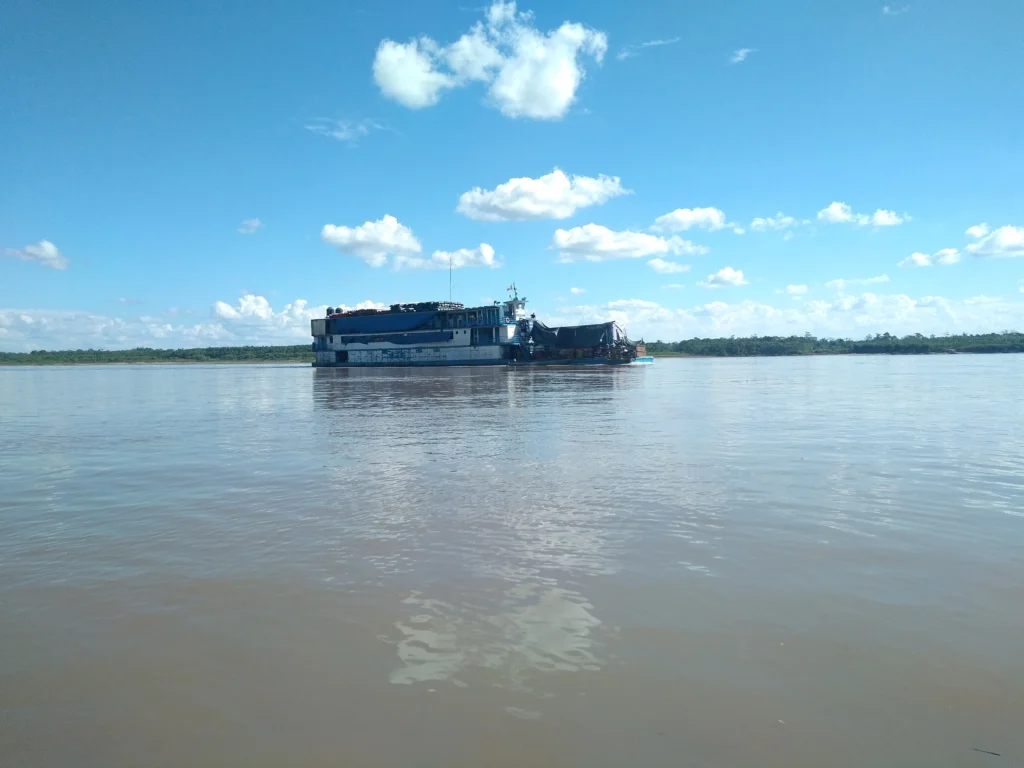
What to expect from a trip to Iquitos?
Excellent idea! Expanding your blog beyond the southern circuit shows you're an expert on the whole country. Many travelers are unsure whether to add the jungle (Iquitos) or the high mountains (Huaraz) to their itinerary, so answering these questions will definitely attract a lot of traffic.
Since Iquitos and Huaraz have very different logistics than your main southern route, I've subtly adapted the closings. For Huaraz, you can offer your transportation service from Lima (it's a spectacular road trip). For Iquitos, since it's only accessible by plane, the closing focuses on your role as a travel organizer and secure transfers in Lima to the airport.
Here are the two articles, ready to be copied and pasted into WordPress.
ARTICLE 11: HUARAZ (Copy from here)
SEO elements
- Entry title (H1): Huaraz Beginner's Guide: How to Acclimate and Which Lagoons to Visit
- Permanent link (Slug):
adventuretoursperu.com/guia-huaraz-aclimatacion-mejores-lagunas - Meta Description: Are you traveling to Huaraz, the trekking capital of Peru? Discover how to avoid altitude sickness and the ideal order for visiting the Parón, Llanganuco, and Laguna 69 lagoons.
Huaraz Beginner's Guide: How to Acclimate and Which Lagoons to Visit
Known as the "Switzerland of the Andes," the city of Huaraz is the ultimate paradise for mountain lovers. Located at the foot of the imposing Cordillera Blanca, it is the starting point for exploring some of the most spectacular turquoise lagoons and glaciers on the planet.
However, Huaraz is not a destination to be taken lightly. The city sits at 3,050 meters above sea level, and most of its attractions are located above 4,000 meters. To ensure your trip is a success and you don't suffer from altitude sickness (soroche), here's the perfect acclimatization guide and the exact order in which you should visit its wonders.
[INSERT IMAGE HERE: A spectacular photo of Laguna 69 or Laguna Parón with snow-capped mountains in the background].
The Golden Rule in Huaraz: From Less to More
The most common mistake travelers make is arriving in Huaraz and then, the very next day, attempting the demanding hike to Laguna 69. The result is almost always a terrible headache and the inability to complete the route. Your body needs time. This is the ideal itinerary to outsmart altitude sickness:
Day 1: Arrival and easy walk (Wilcacocha Lagoon)
Your first day should be very relaxed. Eat lightly and drink plenty of coca tea. If you feel energetic in the afternoon, visit the Wilcacocha Lagoon (3,700 meters above sea level). It is located in the Cordillera Negra (opposite the Cordillera Blanca), the hike is short and will reward you with an incredible panoramic view of the snow-capped mountains.
Day 2: Effortless Altitude (Laguna Parón or Llanganuco)
On your second day, you need to gain altitude but without exhausting your muscles.
- Laguna Parón (4,185 m above sea level): It's the largest lagoon in the Cordillera Blanca. The best part is that vehicles can drive almost right up to the shore. You can take a boat ride, walk along the flat edge, or climb a short rocky viewpoint.
- Llanganuco Lagoon (3,850 meters above sea level): Another option where the car does all the work. It's famous for the intense color of its waters and the queñual trees that surround it.
[INSERT IMAGE HERE: Tourists sailing in a small boat on the turquoise waters of Laguna Parón].
Day 3: The Glacier (Pastoruri Mountain)
Now we're going to break the 5,000-meter barrier. The tour to Pastoruri Glacier (5,000 m above sea level) It allows you to see firsthand the impact of climate change in the Andes. The bus drops you off very close to the glacier; you'll only have to walk for about 40 minutes at a very slow pace along a paved path. Here, your body will truly understand what a lack of oxygen feels like.
Day 4: The Great Challenge (Lagoon 69)
Now you're ready! Laguna 69 (4,600 m above sea level) It requires a hike of about 3 hours each way, with a constant uphill climb. It's a tough trek, but since your body has already acclimatized in the previous days, you'll have the lungs and energy needed to reach the summit and take that dream photo overlooking its turquoise waters.
[INSERT IMAGE HERE: Smiling (and bundled up) tourists celebrating their arrival at Laguna 69].
How to get to Huaraz without sacrificing your comfort
Huaraz is about an 8-hour drive north of Lima. Although there are overnight buses that make the trip, the journey along the Pan-American Highway North and the subsequent climb through the mountains is a visual spectacle worth enjoying during the day and at your own pace.
If you're planning an adventure through Peru and want to include Huaraz with complete ease, in Adventure Tours PeruWe can help you.
- Private Transport Lima – Huaraz: Forget crowded terminals. I'll pick you up at your hotel in Lima in a comfortable private vehicle. We'll travel at your pace, stopping for lunch wherever you like and taking photos at viewpoints before arriving at your mountain hotel.
- Free consultation: Do you have doubts about what type of shoes to wear or whether your physical condition is suitable for Laguna 69? Write me a message. As a tourism professional, I would be happy to guide you and help you put together your itinerary for Huaraz, without any obligation.
👉 [WhatsApp Button/Link] Click here to chat with me. Let's plan your mountain expedition!
ARTICLE 12: IQUITOS (Copy from here on)
SEO elements
- Entry title (H1): Peruvian Jungle: What to Pack and What to Expect on Your First Trip to Iquitos?
- Permanent link (Slug):
adventuretoursperu.com/viaje-iquitos-selva-peruana-que-empacar - Meta Description: Plan your trip to the Peruvian Amazon. Discover how to get to Iquitos, what clothes to pack for the extreme heat, and what to expect from your stay at a jungle lodge.
Peruvian Jungle: What to Pack and What to Expect on Your First Trip to Iquitos?
Imagine a vibrant city, full of motorbikes, exotic markets, and an enveloping heat, completely surrounded by the immense Amazon River and the densest rainforest in the world. That's Iquitos, the largest city in the world to which... It is not accessible by road..
Visiting the Peruvian Amazon is a stark contrast to the cold mountains of Cusco or Puno. It's an experience of pure connection with nature, a break from technology, and pure adventure. If you're venturing into the jungle for the first time, here's exactly what to expect and how to pack your backpack.
[INSERT IMAGE HERE: A boat sailing on the majestic Amazon River, surrounded by intense green jungle].
What to expect from a trip to Iquitos?
1. You are an island in the middle of the green
Iquitos is only accessible by plane (1 hour and 45 minute flights from Lima) or by navigating the river for several days. Upon landing, you'll immediately feel the impact of the humidity and tropical heat (temperatures typically hover around 32°C with humidity exceeding 80%.
2. Life at the Lodge«
The typical experience is not to stay in downtown Iquitos, but to take a boat from the port to venture into the Amazon towards a Lodge (ecological lodge) in the middle of the jungle.
- Total disconnection: Most of the deep jungle lodges They have no Wi-Fi or cell phone signal, And electricity usually only works for a few hours using generators. It's the perfect time for a digital detox.
- Night Symphony: You will sleep listening to the songs of millions of insects, frogs and nocturnal birds, and even howler monkeys at dawn.
3. Unique Excursions
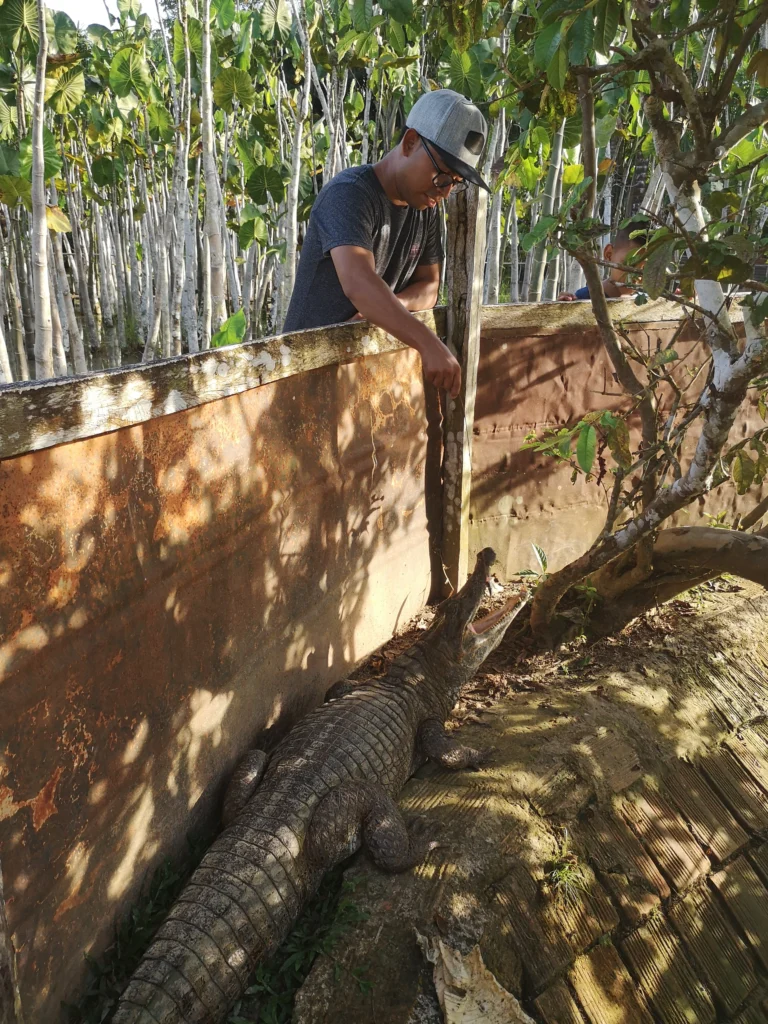
Your days will be filled with activities: mud walks looking for tarantulas and sloths, night sailing to observe caimans, piranha fishing and visits to native communities.
What to Pack: The Amazon Survival List
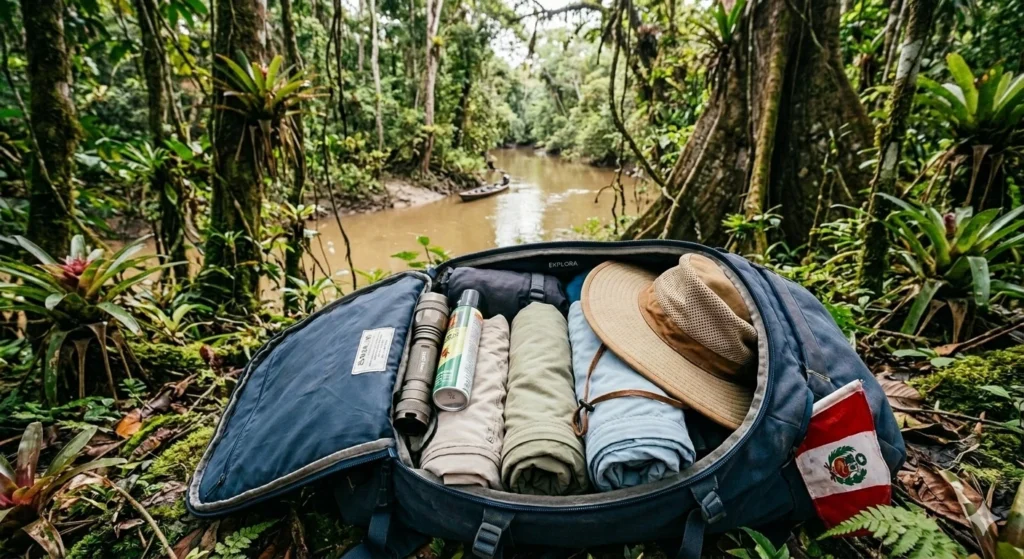
The hot, humid, and mosquito-filled climate dictates exactly what you should pack:
- Light-colored clothing: Mosquitoes are strongly attracted to black, dark blue, and red. Pack clothes in neutral colors (beige, khaki, light green).
- Long pants and long sleeves: Even if it's hot, for jungle walks you need long pants (quick-drying, not jeans!) and lightweight long-sleeved shirts to protect your skin from scratches and insects.
- Strong repellent: Look for one that has at least 20% to 30% of DEET. Apply it generously several times a day.
- Headlamp: Essential for walking around the lodge at night when the generator is turned off, and for nighttime excursions in search of alligators.
- Rain poncho: In the jungle, it can rain cats and dogs from one second to the next at any time of year. A light poncho is better than an umbrella or a heavy jacket.
Your trip through Peru, connected from beginning to end
Planning an itinerary that combines the civilization of Lima, the majesty of Cusco, and the wild nature of Iquitos requires synchronizing many flights and airport transfers.
Since Iquitos is an island surrounded by jungle, my vehicles Adventure Tours Peru They cannot cross the Amazon. However, My commitment as your local expert doesn't end where the roads end..
- Stress-free logistics in Lima: Most flights to Iquitos depart from Lima. I'll take care of your private airport-hotel-airport transfers in the capital, ensuring you never miss a connection to the jungle and that your heavy luggage (the stuff you won't be taking into the Amazon) is safe and sound.
- An Advisor at Your Service: Not sure what order to plan your trip to make sure flights between Cusco and Iquitos work out? Need recommendations for reliable hostels in the jungle? Send me a message. I'd be happy to help you structure your entire itinerary for Peru and recommend the best options, completely free of charge and with the knowledge that only a local professional can give you.
👉 Click here and let's chat. Let's make sure every stage of your trip to Peru goes perfectly!